

Calculated Moves, a growing bookkeeping firm, was hitting a ceiling. Client demand was strong, but manual work, staffing challenges, and preventable errors were draining capacity. The owner found herself spending more time fixing books than serving clients or growing the business.
Challenges:
Before working with us, the owner explained:
“Staffing is always an issue. I don’t care whether you’re offshoring, onshoring, whatever. New staff that’s not highly motivated like I am will make a lot more mistakes. Most of my time was being spent undoing their mistakes and fixing problems that could have been avoided.”
Manual work and inconsistent processes meant that routine bookkeeping tasks were draining valuable time, leaving no bandwidth for client advisory or growth activities.
Solution:
We implemented automation and process improvements designed around the firm’s existing tools.
The focus was not on individual client workflows. Instead, we focused on building standardized systems that applied firm-wide, including:
- Xero reconciliation bots that automatically matched transactions, cutting hours of manual review and reducing errors.
- Automated depreciation journal entries that ensured accuracy and consistency every month without staff intervention.
- Fixed asset discrepancy notifications that flagged issues proactively, so staff could resolve them before the year-end crunch.
The automation tools used included Zapier, Make.com, Xero, Airtable, and Axiom.ai.
Together, these automations replaced dozens of hours of repetitive bookkeeping work with streamlined, dependable processes.
Results:
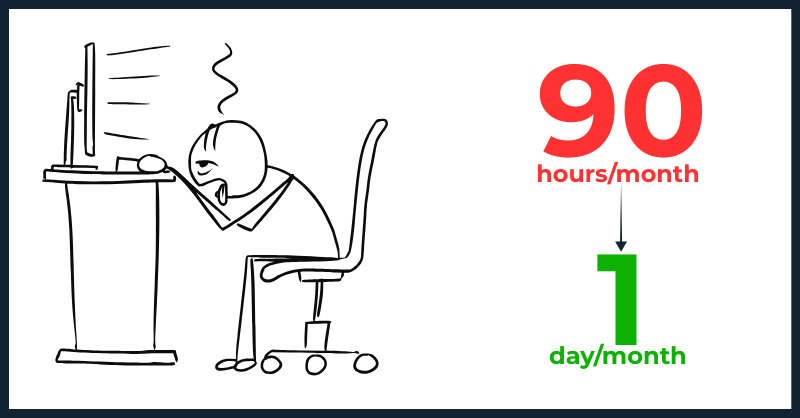
The improvements were measurable and transformative:
- Time savings: A role that took 90 hours per month was reduced to one day a month of the owner’s time.
- Staffing efficiency: The firm no longer needed a full-time bookkeeper to manage 45 client accounts.
- Scalability: Client roster grew from 45 to 60 accounts without adding staff, a 33% increase.
- Repeatable, reliable processes: Automation eliminated most errors, reduced the need for manual fixes, and flagged issues when humans were needed.

The owner emphasized the long-term value:
“Definitely do it. The double benefit? ,To automate a process, you first have to truly understand it. Automation forces you to define and standardize your process, which not only makes it repeatable but also makes it easier for robots or people to execute reliably. Most folks hesitate because they don’t know their process well enough to even explain how to fix it. Solving that unlocks everything.”
